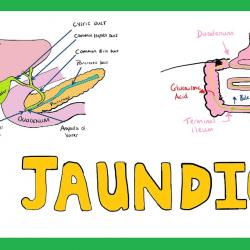
Jaundice is a yellowing of the skin, whites of the eyes and body fluids. It is caused by an increase in the amount of bilirubin in the blood. Bilirubin is a yellow pigment that is produced from the breakdown of haem, mostly from haemoglobin in red blood cells (RBCs). Bilirubin is transported by the blood to the liver, where an enzyme links it to a sugar, a process called conjugation. The conjugated bilirubin is excreted from the liver as bile, eventually reaching the small intestine. Jaundice may arise from an increase the breakdown of red blood cells, from liver disease or from a problem with the excretion of bile.
Examples of common conditions that may cause jaundice
- Haemolytic anaemia: may be caused by an abnormal haemoglobin variant in the red blood cells, malaria, an autoimmune process, haemolytic disease of the newborn or any other condition that lead to a significant increase in the destruction of red blood cells and to an increase in the production of bilirubin. The jaundice is mild and due to unconjugated bilirubin.
- Physiological (normal) jaundice: mild jaundice is seen in more than 50% of newborns due to the immaturity of the baby's liver enzyme which is needed to conjugate bilirubin. It usually appears at 2 to 4 days and disappears by 7 to 10 days. If the jaundice appears early, persists or is severe the infant will be investigated for other causes and is likely to need treatment.
- Gilbert’s syndrome: about 3% of the UK population have this condition. It is associated with decreased bilirubin conjugation in the liver due to an inherited decrease in enzyme activity and therefore reduced excretion in the bile. Those affected may have temporary mild jaundice during times of illness or stress caused by increases in their blood unconjugated bilirubin levels.
- Acute hepatitis: liver inflammation due to a variety of causes including hepatitis A, B, C, D, and E viral infections, alcohol abuse, and some medicines and toxins. More than half of the bilirubin in the blood is conjugated and bilirubin appears in the urine.
- Obstruction of the bile ducts inside or outside the liver may be due to liver damage and scarring in the late stages of cirrhosis, cancer in the liver or biliary atresia, a congenital condition with abnormal development of the bile ducts. Gallstones can block bile ducts and pancreatic cancer can sometimes lead to a blockage of the main bile duct. Back-up of bile behind an obstruction leads to the appearance of conjugated bilirubin in the blood and urine. If the obstruction is severe, the stools become pale.
Examples of more rare conditions that may cause jaundice
- Wilson’s Disease: an inherited disorder of copper metabolism which results in excessive deposits of copper in the liver, causing cirrhosis and jaundice, as well as in the brain and cornea of the eye.
- Alpha 1 Antitrypsin Deficiency: an inherited condition in which defective alpha 1 antitrypsin accumulates in the liver cell causing liver damage and jaundice. The severe form of alpha 1 antitrypsin deficiency is the most common genetic cause of liver disease in babies and children
- Crigler-Najjar syndrome: an inherited condition that may lead to high bilirubin concentrations; a gene mutation leads to a deficiency in the enzyme necessary for bilirubin conjugation.
- Dubin-Johnson syndrome: an inherited disorder that impairs the secretion of bilirubin from liver cells after it has been conjugated; patients may have intermittent jaundice.
- Rotor’s syndrome: an inherited cause of mild intermittent jaundice; similar to Dubin-Johnson without the retention of bilirubin in the liver cells.
- Pseudojaundice: the skin of a person may turn yellowish when they eat large quantities of carrots, pumpkin or melon due to the presence of beta-carotene; a temporary and benign condition not related to bilirubin or bile